

- Energia Family
- The launchers
- Vulkan
- Description
- Characteristics
- Composition
- Energia
- Energia M
- Zenit-2
- Engine
- Gallery
| -The Mriya is destroyed. |
| -Shipping of Buran-KS to Sotchi. |
| -Antonov is no more. |
| -Buran is now a museum. |
| -New pictures of the blogger Ralph Mirebs. |
Rocket launcher "Vulkan" (133ГК)

The begining of researches and experiments studies for the Vulcan rocket was ratified by the Soviet government in July, 1981 and by the specifications of the administration headquarters in July, 1982, according to the five year plan.
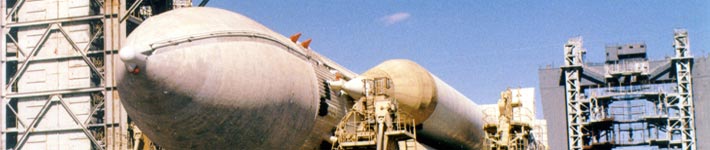
The Vulkan heavy launcher is in the class of unified launchers such as the Zenit, РЛА-125, Energia, Bourane-T, using common engines and rocket blocks unified for the main systems. The first stage consists of 8 boosters, blocks A from the Energia rocket. The second stage, the block Ц, corresponds to the central block of the Energia launcher. The launch pad block which connects the launcher with the ground installations is the new block Я. Finally, the nose cone can have several configurations according to the payload to be put into orbit.
The departure mass of Vulkan is 4747 t. The capacity of the payload at a 200 km height and a slope of 50.7° is 200 t, 172 t for a slope of 97°. 36 t for a geostationary orbit with the use of the block "Vesuvius", 43 t for an orbit towards the Moon and until 52 t for a flight towards Mars.
The elements of the block A are attached by 2, and there is 4 pairs. They are 7m bigger than the blocks of Energia, on the launch pad block As lean on the Я block thanks to 2 supports, unlike block As of Energia who lean on the Я block by to 4 supports. Finally, they are not equipped with return system. block As are divided into 2 groups; left blocks and right blocks; the difference is in the positioning of the separation retro-rockets and in the fixation elements to the central block.
At the start the mass of the block A is 449.2 t, weight of the structure is 57.3 t, the mass of fuel is 386 t of which 278.8 t of oxygen and 107.2 t of fuel. The length of the block is 46.5 m.
The boosters of the block A is powered by engines RD-179 (РД-179) (1 per booster), wich have a thrust of 860 t at sea level and 937 t in vacuum. Their specific impulse (considering the fuel tanks) is of 308.5 s at sea level and 336.2 s in the space.
The central block of the Vulkan launcher distinguishes itself from the Ц block of Energia by: a tank's lengthening increased of 15 m, the change of the shape of the bottom of the superior oxygen tank, a cylindrical skirt on the engines RD-0120 (РД-0120) level (4 units), a symmetric arrangement of the tanks including pipings.
The mass of departure of the Ц block is 934 t, weight of the structure is 89.7 t, the mass of fuel is 832 t of which 713 t of oxygen and 119 t of hydrogen. The engine is RD-0120 which has a thrust of 175 t on Earth and 200 t in the vacuum. The specific impulse is 396 s at sea level and 454.9 s in vacuum. The height of the block is 63 m.
The central block of the Vulkan launcher must be built at Kubichev (Куйбышев) in the Progress factory (Прогресс), the elements of the block A must be built at Omsk (Омск) by the company "the Flight" (Полет).
The launches were foreseen on the universal launch pad of Baikonur. The parameters of Vulkan such as the size and the heat of ejected gases were taken into account for its construction.
vulkan, launcher, rocket, russian, soviet, propellant, block A, booster, central bloc, vulkan, launcher, rocket, russian, soviet, propellant, block A, booster, central bloc, vulkan, launcher, rocket, russian, soviet, propellant, block A, booster, central bloc, vulkan, launcher, rocket, russian, soviet, propellant, block A, booster, central bloc,