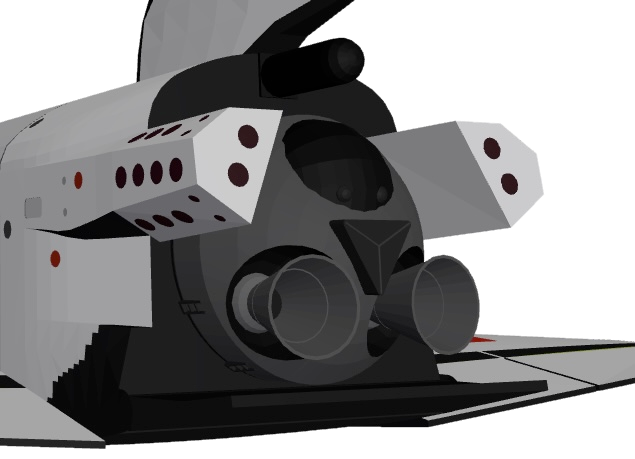
To leave the orbit, the shuttle turns over 180° thanks to the gas orbital maneuvering systems (the tail ahead), then the principal engine begin an urgent braking to give it the necessary impulse to slow down. The shuttle enter the descent trajectory, it turns over 180° again (nose ahead) and get on its trajectory with a great angle of attack. Until the altitude of 20 km the trajectory is controlled by the orbital maneuvering system and the aerodynamics systems (drift, elevons), then on the end of the flight, in fact only the aerodynamic systems are used. The profile of the shuttle ensures a good aerodynamic quality to it, enabling it to carry out a controlled descent on 2000 km, and finally after some operations facing the landing strip. At the same time, the trajectory chosen for the descent makes it possible to compensate the approach speed of the shuttle which is 300 to 360 km/h at the landing time. The length necessary for the landing is 1100 to 1900 m. For the improvement of the exploitation possibilities of Buran, it was planned to use 3 aerodromes, one at the cosmodrome (5 km length, 84 m broad at 12 km of the launching pad), another one in Asia (Horol, in the north of Vladivostok) and another at the West (Simferopol, in Ukraine). The whole radio systems of the aerodrome (500 km of ray), ensure the detection of the shuttle, its return towards the aerodrome (including in automatic mode) and its landing.
The first trial flight of Buran was completed after the execution of 2 revolutions around the Earth, then by the successful landing in automatic mode on the aerodrome in the area of Baikonur. The breaking impulse was started at an altitude of 250 km, at a distance of almost 20 000 km from the aerodrome.
The development of Buran went on 10 years. Ten years during which important research tasks and experiments were carried out in various technical fields: acoustics, thermodynamics, systems design, dynamics of flight on simulator, design of the control panel, making of new materials, developing of methods and equipment for the landing in automatic mode (flying laboratories), atmospheric flight tests of the similar shuttle (another model of Buran with turbines, BTS-002), outsides tests of the heat shield and aerodynamic tests on BOR-4 and BOR-5 models, etc.